
Book review prepared for the August 2026 issue of the Families Journal of the Ontario Genealogical Society.
On one level it may seem a little unusual to be writing a review of a book first published 35 years ago, and perhaps stranger still when we consider that most of the content of the book was first composed 185 years ago. Mute Words, Living Voices: The Letters of Henry Giles, 1843-4 is a compilation of 16 letters written by Henry Giles (1803-1871) of Pelham Township, Lincoln County, Canada West over a thirteen-month period. His expansive and eloquent letters to friends and family, mostly in England, provide a revealing account of life in mid-nineteenth century rural Ontario. Henry was a well-educated Quaker, who had arrived in Upper Canada with his family [1] only two years earlier from Norwich, England. His observations on day-to-day life in his new adopted home are invaluable. He describes the weather, transportation, the economy and his struggles to eke out a living. Several letters read almost like a prospectus, extolling the virtues of his adopted country to family back home.
The book has great value to the genealogical community from several perspectives. If you have ancestors in rural Ontario, or the Counties of Lincoln or Welland in particular, these first-hand accounts provide context and texture for the lives of those ancestors. The letters also mention many of the local Fonthill and Pelham families who Henry interacted with, some of whose descendants are still represented in the community today. It is necessary to approach the letters with an understanding of the times in which they were written. Certain passages or viewpoints expressed may reflect attitudes considered insensitive by today’s standards, though this does not diminish the historical significance of the work.
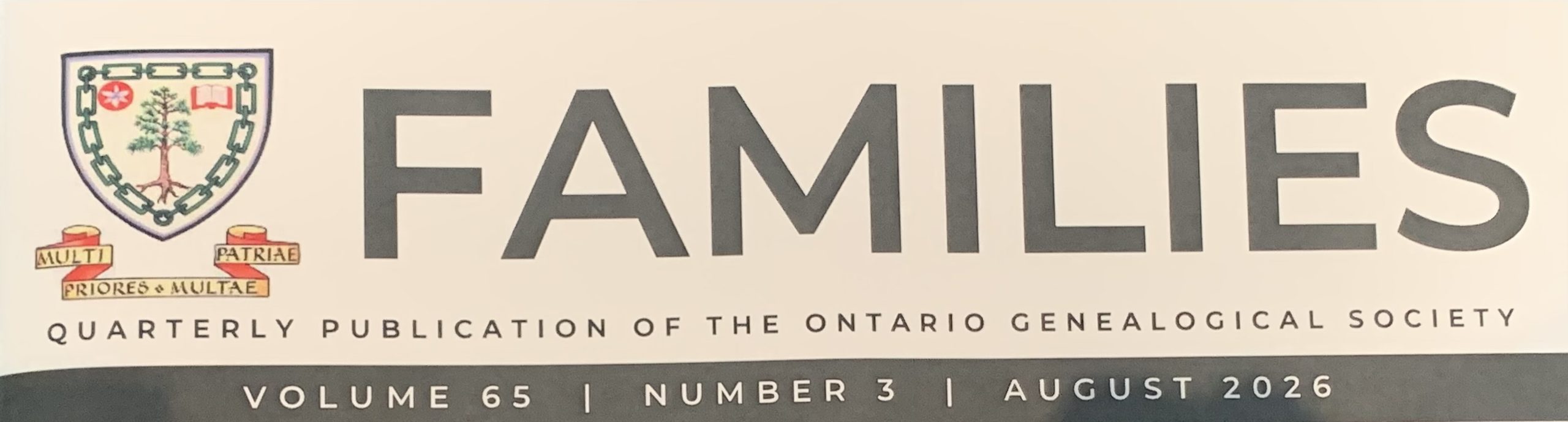
One of the neighbours who Henry mentions is John George Slough (1807-1891), [2] whose grandfather had received a 200-acre land grant for Lots 2&3, Concession V, Pelham Township. [3] In Letter 7 to his brother Robert, Henry mentions that “We have an estate being offered for sale belonging to one George Slough, (probably the slough of despond [4] as his family consists of 6 unmarried daughters) which seems an eligible site for a mill … there are 22 acres available, 12 of which are level enough to plough. The remainder romantic hills … There is a beautiful stream but no dam erected. A fall of 15’ may be obtained.” I’ve done some work on this family in the past so thought I’d dig a little deeper into the rather uncharitable reference to the slough of despond, as well as the land purchase opportunity. The land described was likely occupied by George Slough and his family at the time of the letters, but land records indicate it was still owned by his father George Slough (1777-1851) in 1843. George (1807) did eventually inherit ownership of the 22 acres located at the south end of Lot 3, Concession V through the terms of his father’s 1850 Will, and shows as still owning it in the 1876 H.R. Page Atlas for Lincoln and Welland Counties. Red circles have been added to the crop of that map on the front cover of the book shown above to highlight the location of the Giles 25-acre farm and the George Slough 22-acre farm.
We will never know whether the Henry Giles reference to the land available for sale was wishful thinking, or the Slough family had second thoughts and decided not to sell. The slough of despond depiction probably alluded to the fact that there were no sons to carry on the business of the farm, considered a sad state of affairs in those days. Two sons and three more daughters were eventually welcomed to this family. The six daughters who were listed on the 1851 census as old enough to have been alive in 1843 all went on to marry into successful founding families of central Niagara. These included Clark, Hansler, Tice, Depotty, Lindsay and Singer. Other families referenced often in the book include Oxley, Waite, Hill and of course Giles.
One of the experiences which Henry marvels at is the joy of travelling by horse drawn sleighs in the winter months, explaining how much faster and more comfortable that was than travelling on the rough roads in summer. He also describes the beauty of the Niagara Falls in winter, observed while climbing down into the gorge over the ice using crampons on his feet. For me, part of the magic of this book are the many detailed descriptions of the local economy and the challenges involved in starting up a 25-acre farm (now covered with houses on the west side of Pelham Street North in the heart of Fonthill).
The publication of this book by The Pelham Historical Society (PHS) was a true labour of love for a core group of members and summer students, as well as descendants of Henry Giles. The preservation of the letters is a story unto itself. Henry would laboriously dampen the ink-covered pages and press them onto a fresh sheet of paper creating a mirror image of his longhand script. These letters were preserved carefully in the family for over one hundred years until Henry’s great grandson Leo Giles painstakingly accomplished the task of transcribing them. PHS members, led by Mary Lamb, [5] then prepared the letters for publication and added historical essays on the Township of Pelham and the Quakers of Pelham, as well as helpful footnotes explaining some of the more arcane terms or topics addressed in the letters.
The title selected for this book of letters was drawn from a poem composed by Henry Giles’ brother James, one of the recipients of the letters:
Old Letters [6]
“… They tell of days of innocency, when
We only walked where peace and duty led
They urge us back to that sweet path again
When those who urged us, are not, – and instead
Of reading the mute words of living men
We hear the living words of the dead.”
Mute Words, Living Voices was re-issued by PHS recently and the 67-page book is available at several local Pelham outlets [7] and for remote purchase through Someday Books in St. Catharines.
______
[1] Henry and his wife Hannah Oxley (1804-1880) came to Canada with three sons and a daughter in 1841.
[2] In Pelham the family name is pronounced to rhyme with “scow.” John George’s wife was Dorothy Terryberry (1813-1895).
[3] I have had the good fortune to be able to view the original 225 year old Land Patent issued to George “Slow” (1777-1850) for this property, which is in excellent condition.
[4] Mute Words, Living Voices: The Letters of Henry Giles (Fonthill: The Pelham Historical Society, 1992) 33. “Slough of Despond” is a reference to a line in Pilgrim’s Progress written by John Bunyan (1628-1688). The expression has come to be used as a metaphor for a state of depression or despair.
[5] Mary Lamb (1931-2025) wrote an excellent review of the book for PelhamToday in 2024 to help launch the re-issue – Accessed June 27, 2026 – https://www.pelhamtoday.ca/local-news/history-a-collection-of-letters-that-brings-old-pelham-to-life-9275309
[6] James Giles, Poems: Domestic and Miscellaneous, (London: W.B. Whittington & Co., 1881) 53. Accessed June 27, 2026 – https://books.google.com.hk/books?id=vk4CAAAAQAAJ&printsec=frontcover&hl=zh-TW&source=gbs_ge_summary_r&cad=0#v=onepage&q&f=false
[7] The book is available for $15.00 at Boggio Fonthill Pharmacy & Log Cabin Gift Shoppe, Nature’s Corner Café, and PharmaChoice Pelham